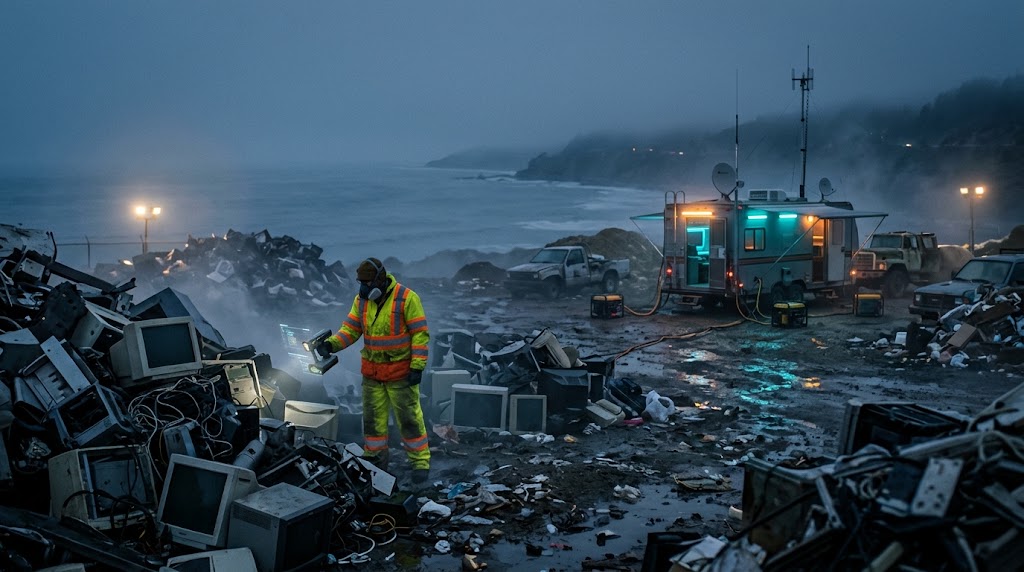
The Million-Dollar Landfill: The 8,000-Bitcoin Hard Drive and the High-Tech Hunt for Digital Gold
Target: The Docksway Landfill Drive
Unspent UTXO: 8,000 Bitcoins • Valuation: $600M+ • Medium: 2.5-inch SATA Mechanical Drive • Burial Depth: ~15 Meters
Buried under hundreds of thousands of tons of decomposing household refuse, compressed cardboard, industrial sludge, and wet Welsh soil lies an unassuming 2.5-inch laptop hard drive. It has no distinctive outer markings, no titanium casing, and no outward features that would distinguish it from millions of obsolete computer peripherals discarded across the globe every single year.
Yet, this single slab of aluminum, silicone, and spinning magnetic platters holds the unencrypted cryptographic private keys to 8,000 Bitcoins. At current market valuations, the contents of that discarded drive represent an astronomical fortune exceeding half a billion dollars—the catalyst for the most expensive personal mistake in human history and an unprecedented high-tech excavation expedition.
The Catastrophic Spill: How 8,000 BTC Ended Up in the Trash
The tragedy originated in early 2009. Satoshi Nakamoto’s groundbreaking whitepaper had just introduced the concept of decentralized peer-to-peer electronic cash to a modest mailing list of cypherpunks. Among the first handful of individuals on Earth to download and execute the initial open-source software client was James Howells, an IT systems engineer living in Newport, South Wales.
At the time, Bitcoin possessed zero fiat value. It could not be traded on liquid exchanges, spent at local stores, or exchanged for British pounds. Howells ran a personal gaming desktop in his bedroom, generating thousands of native coins with negligible electrical overhead. After an accidental lemonade spill short-circuited his laptop motherboard, Howells dismantled the computer for spare components, placing the hard drive containing the critical wallet.dat file into a desk drawer.
In mid-2013, while conducting a domestic house cleanup, Howells placed the hard drive inside a black garbage sack intended for disposal. Intending to throw away a separate, blank drive, he inadvertently handed the drive containing his cryptographic private keys to municipal sanitation workers. By the time he realized the error, the garbage truck had already emptied its load into the local council landfill.
2009: 8,000 BTC mined on bedroom PC [Value: $0.00]
2013: Drive mistakenly thrown in trash [Value: $800,000]
2017: Bitcoin breaches $20,000 [Value: $160,000,000]
2024-2026: Bitcoin surpasses $90,000 [Value: $720,000,000+]
The Science of Platter Survival: Can Data Outlive a Landfill?
To the average observer, attempting to restore a consumer electronic component buried fifteen meters beneath toxic subterranean waste for over a decade sounds like sheer delusion. However, mechanical hard disk drives operate on principles fundamentally different from modern solid-state storage (SSDs):
- Solid State vs. Magnetic Platters: SSDs store information as electrical charges trapped inside microchips; without power, these charges inevitably leak over years, resulting in total bit-rot. In contrast, mechanical hard drives write data as physical magnetic orientations permanently etched onto rigid aluminum, glass, or ceramic platters.
- Hermetically Sealed Chambers: While the exterior logic circuit board (PCB) and spindle motor are almost certainly corroded by acidic landfill leachate, the internal drive platters reside inside a sealed, dust-proof chamber.
- Cleanroom Laser Recovery: Forensic recovery firms like Ontrack—the company that successfully recovered 99% of data from the disintegrated Columbia Space Shuttle hard drive—do not simply connect damaged drives to wall power. Technicians unseal the platters in an ISO Class 4 cleanroom, mount them onto laboratory spin-stands, and read the raw magnetic grain using high-precision optical laser sensors.
“As long as the glass-ceramic platter itself has not been physically crushed or shattered into pieces by heavy earthmovers, the magnetic state of the data remains intact. Physics preserves the mathematics.”
— Forensic Hardware Recovery Assessment
The $12 Million AI Excavation Blueprint
Recognizing that a standard backhoe excavation was environmentally unacceptable, Howells secured backing from international venture capitalists to engineer a state-of-the-art $12 million autonomous recovery operation:
1. Artificial Intelligence Sorting Arrays
Excavated material is fed into automated sorting conveyors equipped with spectral optical sensors and neural vision models trained on thousands of variations of deformed hard drive casings. Matching components are instantly isolated via high-pressure pneumatic air ejectors.
2. Robotic Security Patrols
To prevent dangerous nocturnal trespassing, the site would be secured 24/7 by autonomous Boston Dynamics “Spot” robotic quadruped dogs equipped with thermal cameras and LiDAR perimeter surveillance.
3. Environmental Sealing & Green Transformation
The proposal includes dynamic methane extraction bio-filters, total ecological remediation of the landfill site, and a binding pledge to transform the capped facility into a clean community solar farm upon project completion.
The Ultimate Lesson in Absolute Ownership
Despite Howells pledging 10% of the recovered funds directly to municipal public works—a sum that could revitalize local schools and healthcare—the Newport City Council has continuously rejected excavation permits, citing ecological concerns and the speculative nature of the search. The battle has since escalated into high-stakes judicial court challenges.
The Newport landfill stands as the ultimate technological parable of the decentralized era. In our modern digital architecture, mathematical cryptography grants sovereign control over wealth—yet that control is bound to absolute personal responsibility. There are no customer support lines to override a forgotten key. Until the Welsh earth yields its secret, those 8,000 Bitcoins remain an untouched, modern digital El Dorado resting silently beneath the sod.








Post Comment