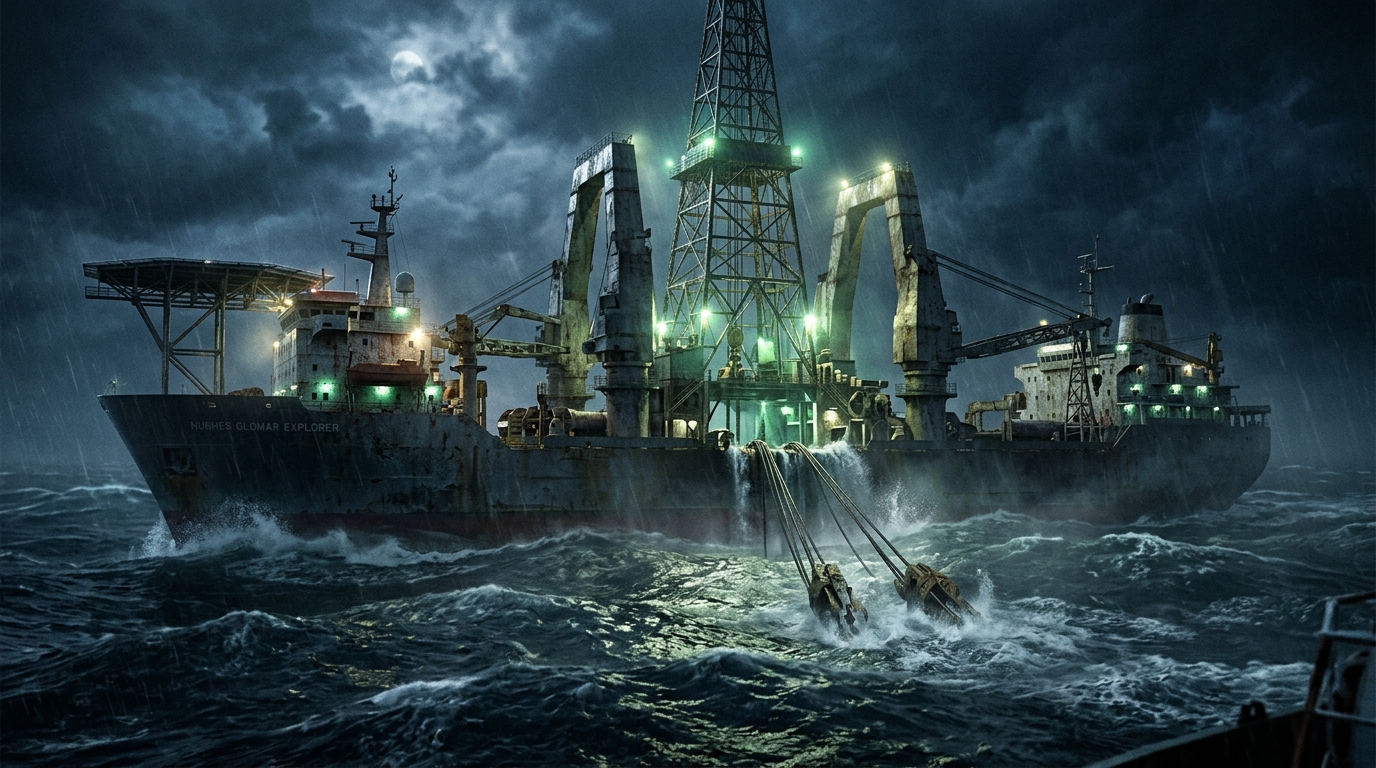
Project Azorian: The Impossible Deep-Sea Heist That Defined Covert Engineering
Mission: Recovery of Soviet Submarine K-129
Depth: 5,000 Meters (16,500 Feet) • Budget: ~$800 Million ($4.5B Today) • Cover Identity: Hughes Glomar Explorer
In the spring of 1968, in the freezing, pitch-black waters of the Central North Pacific, an underwater catastrophe of catastrophic proportions unfolded in complete secrecy. A Soviet Golf II-class ballistic missile submarine, designated K-129, suffered a catastrophic internal explosion and plummeted three miles straight down to the abyssal seabed.
Onboard were three R-21 nuclear ballistic missiles, two nuclear-tipped torpedoes, the complete cryptographic codebooks of the Soviet Navy, and eighty-six young submariners. The Soviet Navy launched a massive maritime search involving dozens of warships, but operating under strict radio silence, Moscow had no coordinates. After two months of searching millions of square miles of ocean, the Kremlin abandoned the effort, concluding K-129 was lost forever.
What Soviet leadership did not realize was that the United States military had heard the explosion. Utilizing SOSUS (Sound Surveillance System)—a clandestine undersea network of acoustic hydrophones anchored across the seabed—U.S. naval intelligence calculated the exact acoustic epicenter. They located K-129 resting 16,500 feet beneath the waves. What followed was the most audacious, technologically unprecedented, and expensive covert intelligence mission of the 20th century: Project Azorian.
The Audacity of the Challenge: Lifting a Mountain from the Abyss
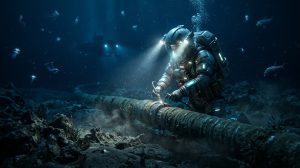
Lifting a 1,750-ton mangled steel submarine from a depth of three miles was something human engineering had never even contemplated. At 16,500 feet, the marine environment is unsparing:
- Crushing Hydrostatic Pressure: Water pressure exceeds 7,500 pounds per square inch (psi)—sufficient force to collapse an armored vehicle like an empty aluminum can.
- Cable Impossibility: No crane on Earth possessed cables capable of lifting that weight without snapping under the gravitational drag of their own length. The CIA concluded they had to invent a completely new genre of marine engineering.
The Howard Hughes Cover Story
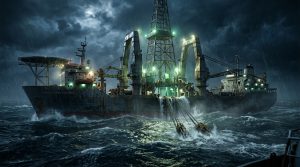
How does an intelligence agency construct a 618-foot, 36,000-ton salvage vessel equipped with a 200-foot derrick without alerting Soviet spy networks or the investigative press? The CIA turned to the eccentric billionaire, aviator, and industrialist Howard Hughes.
Hughes agreed to act as the public corporate front. The cover story was brilliant: Hughes announced that his Summa Corporation was building an experimental deep-sea mining ship—the Hughes Glomar Explorer—to pioneer commercial extraction of manganese nodules from the Pacific floor. Global media, Wall Street analysts, and Soviet KGB intelligence swallowed the narrative completely.
“The genius of Project Azorian was not just the mechanical engineering; it was the psychological engineering. We hid the most complex naval salvage ship in history in plain sight, with the entire world cheering Hughes for his entrepreneurial spirit.”
— Declassified CIA Historical Monograph
The Mechanical Monster: “Clementine”
The technological marvel of the ship was the “Moon Pool”—a massive internal water hangar hidden entirely inside the ship’s hull below the waterline. The bottom of the ship featured colossal hydraulic doors that opened beneath the sea, shielding operations from spy satellites.
Inside was the Capture Vehicle, nicknamed “Clementine”:
- A 2,000-ton mechanical claw with articulated hydraulic capture arms designed to cradle the submarine hull like giant skeletal fingers.
- The claw was lowered not by cables, but by an unbroken column of heavy 30-foot steel pipe sections, screwed together one by one through the central derrick over weeks of robotic assembly.
The Mission and Structural Fracture: July 1974
In July 1974, the Glomar Explorer held station over the coordinates in the North Pacific. Deep-sea sonar guided Clementine down until its massive steel fingers closed around K-129. The submarine was unstuck from the seabed sediment, and the lift began.
For miles, the ascent proceeded smoothly. But when the submarine was roughly 9,000 feet beneath the surface, tragedy struck: several grabber arms suffered catastrophic structural fractures. With support compromised, two-thirds of the submarine broke away and plummeted back to the abyssal floor.
However, Clementine held onto the forward 38-foot bow section. The claw hauled this portion into the Moon Pool, the hull doors sealed, and forensic intelligence extraction commenced.
🎖️ The Honor at Sea & The “Glomar Response”
Burial at Sea: The bodies of six Soviet submariners were recovered. The CIA conducted a solemn formal military burial at sea with Soviet naval anthems, later delivering the video recording to Russian President Boris Yeltsin in 1992.
The Legal Legacy: When journalists uncovered the operation in 1975, the CIA created the famous legal standard: “We can neither confirm nor deny the existence of the records requested.”
The Enduring Monument of Project Azorian
Project Azorian cost an estimated $800 million (over $4.5 billion today). While naval historians continue to debate the full extent of the intelligence retrieved, engineers universally agree on its significance: it stands as the most daring maritime recovery in human history—demonstrating that even three miles of crushing ocean cannot bury the secrets of modern technological history.




Post Comment