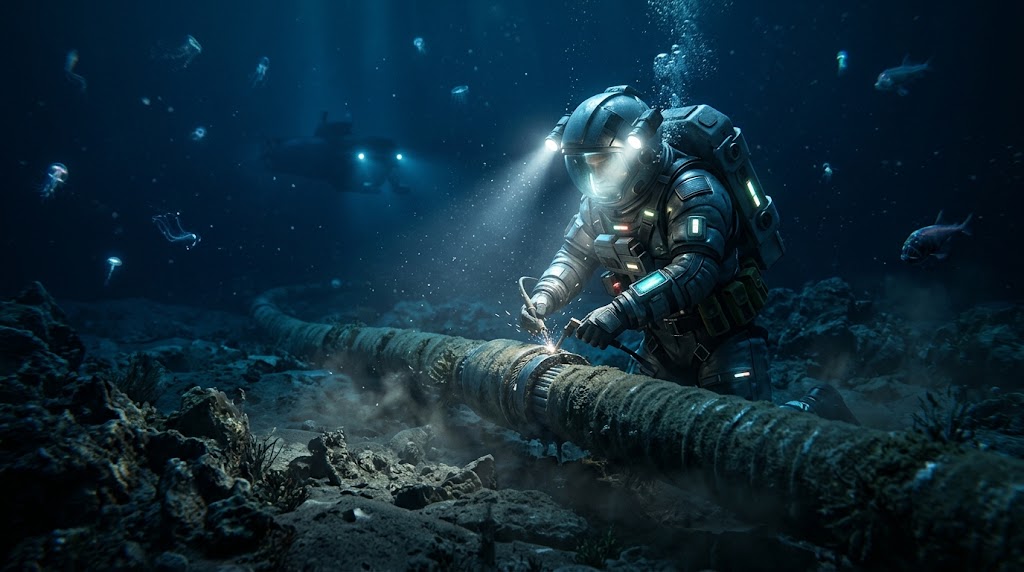
The Deep-Sea Cable Divers: The Unsung Heroes Who Brave Ocean Storms to Save the Internet
The Ocean Floor Superhighways
Global Coverage: 99% of Transoceanic Data • Total Length: 1.4 Million Kilometers • Operating Depth: Up to 20,000 Feet Below Sea Level
Whenever we tap our smartphones to stream a video, execute a financial trade, or send an instant message to someone on the other side of the planet, we instinctively look up toward the clouds. We imagine invisible satellite signals bouncing effortlessly through space from orbit. The reality of modern telecommunications is far more daring, dangerous, and grounded in the freezing abyss of the world’s deepest oceans.
Over 99% of all international internet traffic travels through a silent, fragile network of subsea fiber-optic cables resting in the mud thousands of feet beneath the waves. And when an underwater earthquake, a drifting ship anchor, or a ferocious winter cyclone snaps these glass arteries, an elite guild of specialized maritime engineers and deep-sea divers must venture into towering ocean swells to splice the world back together.
The Fragile Anatomy of an Undersea Cable
Despite carrying hundreds of terabits of data per second across thousands of miles of ocean, submarine cables are surprisingly slender. In deep abyssal waters, where human activity is minimal, an international fiber-optic cable is barely thicker than a standard household garden hose—approximately 17 to 20 millimeters in diameter.
Inside this slender protective casing lies a layered masterpiece of materials engineering:
- Polyethylene Sheathing: The outermost layer that resists the corrosive chemical properties of high-salinity seawater.
- Mylar Tape & Stranded Steel Wires: High-tensile steel armor designed to withstand immense gravitational tension during laying and recovery operations.
- Copper Power Conductor: Supplies thousands of volts of direct electrical current to power inline optical amplifiers (repeaters) stationed every 40 to 60 miles along the seabed.
- Water-Resistant Petroleum Jelly: A thick hydrophobic barrier that seals the core against microscopic water leaks.
- Hair-Thin Glass Optical Fibers: The sacred center of the cable, carrying laser pulses that flash billions of times per second across oceans.
The Perils of the Deep: What Breaks the Internet?
Contrary to popular imagination, shark attacks account for less than one percent of modern submarine cable faults. The deep seabed is a surprisingly hostile and volatile landscape:
Commercial Maritime Accidents (The Primary Threat)
Approximately 70% of all subsea cable cuts are caused by commercial fishing gear and dragging ship anchors. Heavy bottom-trawling fishing nets scrape across the seabed like giant bulldozers, snagging cables and bending them past their breaking point.
Subterranean Avalanches & Earthquakes
Tectonic shifts near continental shelves trigger colossal underwater mudslides called turbidity currents. These underwater avalanches travel down ocean trenches at speeds exceeding 40 miles per hour, snapping multi-ton armored steel cables like dry twigs across hundreds of square miles.
“When a major trans-Atlantic cable snaps, you don’t have the luxury of waiting for calm spring weather. You mobilize a ship in forty-foot swells, hold position with satellite thrusters, and send mechanical claws three miles into the dark.”
— Chief Operations Engineer, Global Marine Systems
The Emergency Mobilization: Ships That Never Sleep
When a cable break occurs, international consortiums immediately alert specialized cable-repair ships that remain docked on standby in ports worldwide—from Brest in France to Cape Town, Singapore, and Halifax. Within 24 hours, the crew must load hundreds of miles of spare fiber, specialized joint kits, and enough provisions to survive weeks of relentless oceanic weather.
Locating a severed fiber line thousands of feet beneath the surface requires extraordinary technical finesse. Shore stations shoot an optical laser pulse called an Optical Time-Domain Reflectometer (OTDR) down the broken fiber. By measuring the precise nanosecond the light reflects back from the glass fracture, engineers calculate the break’s distance from shore down to a few dozen meters.
The Surgical Art of Deep-Sea Splicing
Once on site, the ship lowers colossal Remotely Operated Vehicles (ROVs)—multi-ton tracked robotic submersibles equipped with high-definition cameras, hydraulic cutting arms, and jet-water trenching nozzles. In coastal waters where diving is possible, commercial saturation divers descend in pressurized diving bells to inspect the damage directly.
The ROV slices through the damaged section, clamps onto the intact cable end, and brings it up to the surface deck of the ship. Inside the ship’s climate-controlled jointing laboratory, master fiber splicers perform microscopic surgery:
How a Broken Cable Is Reconnected:
1. Stripping the Steel: Technicians peel away layers of bitumen, steel wire armor, and copper casing without damaging the fragile glass fibers within.
2. Fusion Splicing: Master technicians use high-voltage electrical arcs to melt and fuse the microscopic glass cores together under high-magnification microscopes. A single dust particle can degrade the laser transmission.
3. Universal Joint Sealing: The repaired splice is encased inside a massive, pressure-resistant steel capsule known as a “Universal Joint,” built to withstand thousands of pounds of hydrostatic pressure for the next thirty years.
The Unsung Guardians of Human Connection
Once the joint is sealed and electrical continuity is verified, the heavy cable is carefully lowered back down into the ocean abyss, where the ROV uses high-pressure water jets to bury it safely beneath two meters of seabed mud to protect it from future fishing nets.
While artificial intelligence and cloud algorithms capture the public imagination, the foundational reality of our digital civilization remains mechanical, salty, and cold. The global economy runs not on magic, but on the courage and precision of the men and women who brave the midnight storms of the North Atlantic and the Pacific to keep the world talking.








Post Comment