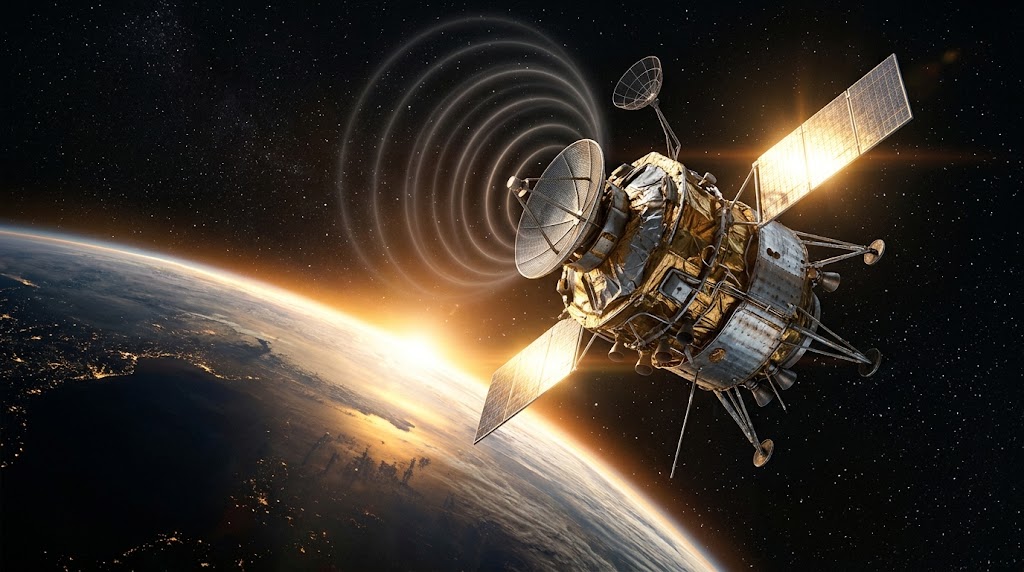
The Ghost Satellite: How a Defunct 1965 Spacecraft Came Back to Life After 46 Years
Target: Lincoln Experimental Satellite 1 (LES-1)
Launch Date: February 11, 1965 • Declared Dead: 1967 • Ghost Signal Detected: 2013 • Silent Gap: 46 Years
In deep space, silence is considered absolute and eternal. When a man-made satellite runs out of chemical propellant, suffers battery degradation, or experiences a terminal hardware freeze, it is written off by orbital tracking agencies as space debris. It becomes an inert metallic tombstone destined to wander the freezing vacuum of space for centuries.
Yet, in early 2013, an amateur radio astronomer scanning the airwaves from the rugged coastline of Cornwall, England, intercepted a ghostly radio pulse that defied every established doctrine of aerospace engineering. Tumbling uncontrolled through high Earth orbit, an obsolete piece of 1960s Cold War hardware had suddenly powered up and resumed broadcasting across the cosmos. It was LES-1—a satellite officially declared dead in 1967.
The Birth of a Cold War Pioneer
To understand the resurrection of LES-1, one must travel back to the height of the Space Race. In the early 1960s, global military communications were dangerously vulnerable. Long-distance communications relied heavily on high-frequency radio waves bounced off the ionosphere—a medium that could be easily jammed, intercepted, or wiped out by solar storms and nuclear detonations.
Under contract with the United States military, researchers at the prestigious MIT Lincoln Laboratory embarked on an ambitious program to design the Lincoln Experimental Satellite series. Their objective was revolutionary: create compact, highly reliable tactical satellites utilizing cutting-edge solid-state electronics, experimental horn antennas, and early silicon solar cells.
On February 11, 1965, LES-1 was launched from Cape Canaveral atop a mighty Titan IIIA rocket. However, during the critical ascent phase, catastrophe struck: an electrical wiring error prevented the spacecraft’s onboard solid-propellant booster motor from igniting. Instead of achieving its planned circular orbit, LES-1 was left stranded in an eccentric, tumbling trajectory, spinning wildly through space like an unbalanced wheel.
The Decades in the Frozen Dark
For two agonizing years, the tumbling satellite sent back distorted, erratic telemetry to MIT ground engineers before its onboard batteries finally succumbed to exhaustion in 1967. NASA stamped the mission as a total operational failure. LES-1 was officially cataloged as space debris: Object ID 1965-009A.
For the next forty-six years, the dead satellite traversed the vacuum of near-Earth space in complete obscurity. It survived conditions that would disintegrate ordinary consumer electronics:
- Violent Thermal Cycling: Plunging from blistering temperatures of +120°C in direct sunlight to -150°C in the shadow of Earth every few hours.
- Solar Proton Storms: Bombardment by high-energy cosmic rays, solar flares, and micro-meteoroid impacts that pit and scour metallic surfaces.
- Severe Vacuum Exposure: Chemical outgassing that strips away conventional lubricants, adhesives, and insulation materials.
“When I first detected the signal on 237 MHz, it sounded like a slow, rhythmic ghost tapping on the radio. It wasn’t random static. It had the precise, disciplined signature of an artificial transmitter from another era.”
— Phil Williams, British Amateur Radio Astronomer
The Autopsy of a Miracle: How Did It Wake Up?
When radio astronomers confirmed that the 2013 signal was originating directly from LES-1, aerospace engineers around the world scrambled to solve the mystery. How could a 1960s satellite with dead batteries miraculously restart after half a century?
Electronic engineers reconstructed the circuit diagrams and pieced together the fascinating chain of events:
The Solar Resuscitation Chain:
1. The Battery Breakdown: Over four decades of harsh space radiation, the satellite’s original chemical batteries completely disintegrated internally, causing their materials to disintegrate and short-circuit.
2. The Direct Circuit Bypass: Paradoxically, this physical breakdown removed the electrical resistance that had been blocking current from flowing directly from the solar panels to the transmitter.
3. Pure Solar Power: Whenever the tumbling satellite enters direct sunlight, its vintage 1965 solar arrays generate enough raw electrical current to power the solid-state transmitter directly, completely bypassing the dead batteries.
4. The 4-Second Pulse: Because the satellite continues to tumble erratically through orbit, its solar panels and directional antennas sweep past the sun and Earth every four seconds, creating the hypnotic, pulsing broadcast received by ground stations.
The Lost Art of Over-Engineering
The survival of LES-1 offers a profound commentary on the evolution of human technology. Modern consumer electronics—and even contemporary commercial satellites—are frequently designed with planned obsolescence in mind, relying on delicate microprocessors with microscopic tolerances that fail after a few years of radiation exposure.
The early engineers of the MIT Lincoln Laboratory, working before the invention of microprocessors, built systems using heavy discrete transistors, robust ceramic capacitors, and point-to-point soldered connections. They over-engineered every single component to withstand the absolute worst-case scenario of space warfare. That stubborn, rugged manufacturing allowed a 1965 artifact to outlive the nation that designed its rocket boosters.
A Cosmic Time Capsule in the Sky
Today, LES-1 continues its silent, lonely dance through the heavens. It carries no modern scientific instruments, transmits no encrypted military secrets, and poses no threat to modern orbital networks. It simply tumbles through the void, catching the morning rays of the sun every four seconds to sing its ancient, electronic song.
It remains one of the most poetic relics of human exploration: an accidental time capsule from the dawn of the Space Age, proving that sometimes, human curiosity and engineering can outlast time itself.






Post Comment