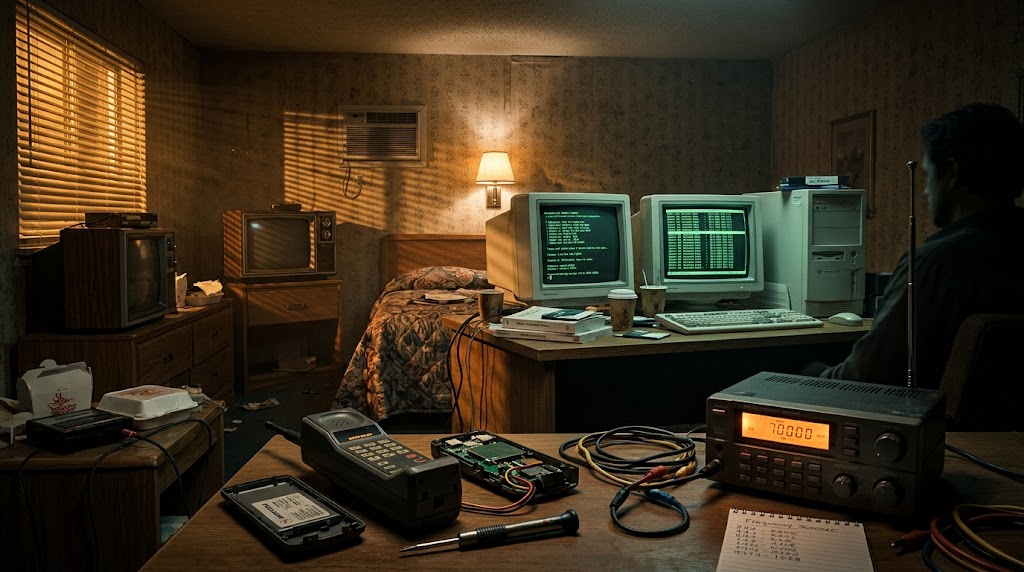
The Digital Manhunt for Kevin Mitnick: The Phantom Phreaker Who Outsmarted the FBI
Target: Kevin David Mitnick (The Condor)
Primary Weapon: Social Engineering & Dial-Up Phreaking • Time on the Run: 2.5 Years • Status: Captured Feb 15, 1995
In the early 1990s, before modern fiber-optic broadband, cloud firewalls, or two-factor authentication existed, a lone fugitive armed with a beige telephone receiver, a patched laptop, and an extraordinary gift for verbal deception brought corporate telecommunication empires and federal law enforcement agencies to their knees.
His name was Kevin David Mitnick, known across underground dial-up bulletin boards by his hacker handle: “The Condor.”
For more than two years on the run from the United States Federal Bureau of Investigation (FBI), Mitnick vanished into the fabric of American society. He cloned cellular identities, infiltrated the internal networks of Sun Microsystems, Motorola, and Nokia, and monitored the very FBI wiretaps that were trying to track him down. The pursuit culminated in the most famous technological manhunt of the 20th century.
The Hacker Who Never Wrote Malware
Contrary to Hollywood depictions of hackers writing complex viral code or brute-forcing 128-bit encryption keys, Mitnick’s greatest technological weapon was profoundly human: Social Engineering.
Mitnick understood long before modern cybersecurity firms that human psychology is the ultimate vulnerability in any security architecture. By calling corporate switchboards, impersonating telecom technicians, internal auditors, or panicked executives, he could convince employees to willingly read administrator passwords, mail unreleased source code on magnetic tapes, or re-route secure trunk lines.
“People were constantly searching for software vulnerabilities and hardware backdoors, but the real backdoor was always the person sitting at the terminal. You could crack the human operating system with five minutes of conversation.”
— Kevin Mitnick, Author of “The Art of Deception”
The Fatal Infiltration: Hacking Tsutomu Shimomura
Mitnick’s downfall began on Christmas Day 1994, when he launched a sophisticated IP-spoofing attack against the personal home computer workstation of Tsutomu Shimomura, a brilliant computational physicist and cybersecurity researcher based at the San Diego Supercomputer Center.
Mitnick successfully exfiltrated Shimomura’s custom cryptographic tools and cellular phone security research. But in doing so, he provoked the wrong adversary. Shimomura took the intrusion as a personal vendetta, joining forces with federal authorities and the New York Times cybersecurity reporter John Markoff to track the ghost hacker across America.
GTE Central Office, Raleigh, NC ──> Detected cloned Motorola cellular handshake
│
▼
Mobile Surveillance Van ──> Traced RF signal with directional antenna to apartment complex
│
▼
Handheld Frequency Wand ──> Pinpointed physical doorway: Apt 202, Duraleigh Hills
The Midnight Raid in Raleigh
By tracing dialed data packets through a local internet provider, Shimomura and telecom security agents tracked Mitnick to a quiet suburban apartment complex in **Raleigh, North Carolina**.
In the middle of the night on February 15, 1995, Shimomura walked down the breezeways of the apartment complex carrying a handheld directional antenna connected to an analog frequency scanner. When he stood outside the door of Apartment 202, the signal meter pegged at maximum power. Federal agents breached the door shortly after 1:30 AM, arresting Mitnick without incident.
⚖️ The 5-Year Solitary Confinement Myth
During his pre-trial detention, prosecutors famously convinced a federal judge to place Mitnick in total solitary confinement without telephone access by asserting that he was capable of “starting a nuclear war simply by whistling modem dial-tones into a payphone receiver.” Mitnick spent five years in prison before re-emerging as one of the world’s most sought-after corporate security consultants.
From Digital Outlaw to Industry Icon
Mitnick passed away in July 2023, leaving behind an indelible legacy that helped establish the entire profession of ethical hacking and penetration testing. The mythic manhunt of 1995 marked the precise moment when computer hacking graduated from adolescent curiosity into serious national security reality—proving that the most formidable firewall on Earth is useless if someone can simply charm their way through the front door.









Post Comment