Operation Morning Light: The Nuclear Satellite Crash in the Frozen Canadian Wilderness
Incident: De-orbit of Soviet Satellite Kosmos 954
Payload: BES-5 Nuclear Reactor (50 kg Uranium-235) • Crash Date: Jan 24, 1978 • Debris Field: 124,000 sq km (Northwest Territories)
In the predawn freezing darkness of January 24, 1978, a blinding fireball illuminated the jagged sub-zero skies above Canada’s Northwest Territories. Trailing a dense shower of glowing embers and sonic booms across the frozen expanse of Great Slave Lake, an unguided artificial satellite tore through the upper atmosphere and disintegrated.
It was not a standard weather satellite or communications relay. The fallen spacecraft was Kosmos 954—a top-secret Soviet ocean reconnaissance satellite (RORSAT) designed to track NATO nuclear submarines using powerful radar. And to power that radar, the spacecraft carried an onboard **BES-5 nuclear reactor fueled by more than 50 kilograms (110 pounds) of weapons-grade Uranium-235**.
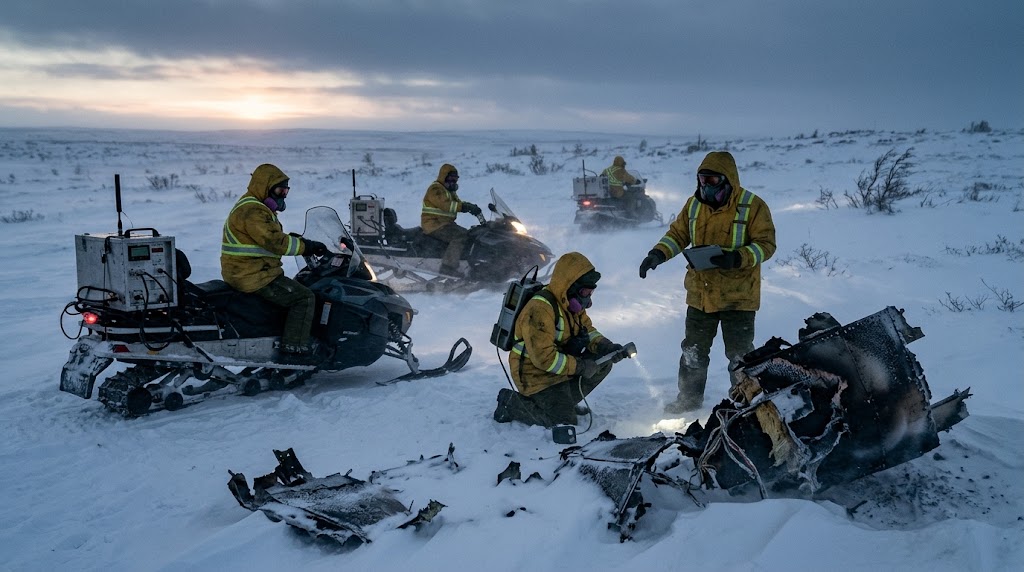
What followed was Operation Morning Light: an unprecedented, harrowing Arctic recovery mission conducted in secret by Canadian Armed Forces and United States nuclear emergency response teams across 124,000 square kilometers of frozen wilderness in temperatures dropping below -40°C.
The Reactor That Refused to Die in Space
Cold War maritime surveillance required intense electrical power. Solar arrays were too weak to power the Soviet high-frequency radar transmitters in low Earth orbit. As a result, the Soviet Union launched dozens of miniaturized nuclear reactors into space.
Standard operating procedure dictated that when a RORSAT reached the end of its operational life, an automated explosive separation charge would jettison the reactor core into a safe, permanent “graveyard orbit” hundreds of miles above Earth, where it would remain untouched for centuries. In late 1977, Kosmos 954 suffered a catastrophic system freeze: the booster rockets misfired, trapping the nuclear reactor in a rapidly decaying orbital death spiral.
The Hunt Across the Frozen Abyss
Within hours of atmospheric re-entry, Washington and Ottawa mobilized the **Nuclear Emergency Search Team (NEST)**. Operating out of the remote military staging base at CFB Edmonton, scientists equipped modified transport aircraft with high-sensitivity gamma-ray spectrometers to scan the vast Arctic ice sheets.
Total Search Area: 124,000 km^2 (Roughly the size of Austria)
Ground Temperatures: -40°C to -50°C (Severe Windchill Blizzards)
Radioactive Hotspots Found: Over 4,000 radioactive particles collected
Highest Radiation Lethality: 500 Roentgens/Hour (Lethal in a few hours of contact)
When ground recovery teams deployed on snowmobiles and dogsleds into the frozen taiga, they encountered a nightmare scenario: the satellite had not remained in one piece. The nuclear reactor core had pulverized upon re-entry, dusting hundreds of miles of frozen lakes, caribou hunting grounds, and indigenous communities with microscopic radioactive debris.
“We found one chunk of core strut sitting on the ice that was emitting 500 roentgens per hour. If a hunter or a sled dog had curled up next to it for warmth overnight, they would have been dead by morning.”
— Canadian Military Radiation Recovery Officer
The “Cup of Uranium” and Diplomatic Reckoning
Over eight grueling months of Arctic operations, search teams retrieved approximately **0.1% of the satellite’s fuel** in the form of intact metallic fragments, including the infamous “finger-sized rod” that was so radioactive it was transported inside a 1,000-pound lead-shielded pig on an emergency cargo flight.
The international fallout was swift. Under the 1972 **Convention on International Liability for Damage Caused by Space Objects**, Canada formally billed the Soviet Union for **$6,041,174.70 CAD** to cover the immense cost of the Arctic military search operation. After protracted Cold War diplomatic negotiations, Moscow quietly paid Canada **$3 million CAD** in full settlement—the first and only time a government has ever paid reparations for damage caused by a fallen spacecraft.
The Legacy of Nuclear Spaceflight
Operation Morning Light forced both superpowers to drastically curtail the deployment of nuclear-powered satellites in low Earth orbit. The Arctic tundra slowly healed, with the remaining unrecovered microscopic radioactive dust decaying harmlessly into the permafrost over decades.
Yet, the silent drama of Kosmos 954 remains an unforgettable chapter in aerospace history: a chilling reminder that the geopolitical battles of the Cold War were not confined to the atmosphere, and that the machines we send into the heavens can return with deadly force to the most isolated corners of our world.





Post Comment