The Deepest Echo: The True Scientific Saga Behind the Kola Superdeep Borehole
Borehole SG-3: Descent to the Deep Crust
Final Depth: 12,262 Meters (40,230 ft) • Target: Continental Moho Boundary • Bottom Temp: 180°C (356°F)
During the height of the Cold War, the international battle for scientific supremacy was fought outward toward the heavens. The United States and the Soviet Union hurled satellites into orbit, deployed astronauts into vacuum, and spent billions racing to plant ideological flags on the lunar surface.
Yet, while the gaze of humanity was transfixed by the void of deep space, a dedicated team of elite Soviet geologists and mechanical engineers embarked upon an expedition into an environment that was equally hostile, enigmatic, and utterly unexplored: the deep interior of planet Earth.
Situated in the desolate, sub-zero tundra of the Kola Peninsula near the border of Norway, their objective was breathtaking in its audacity: drill entirely through the Earth’s continental crust until they touched the elusive Mohorovičić discontinuity—the boundary where the crust gives way to the mantle. Spanning over two decades of grueling labor, the project produced the Kola Superdeep Borehole (SG-3), reaching an astonishing depth of 12,262 meters (7.62 miles). To this day, it remains the deepest artificial hole ever carved into the flesh of our world.
Overcoming Physics: How Do You Drill 7 Miles Straight Down?
Drilling into the deep crust is not simply a matter of manufacturing a longer drill bit. When a column of industrial steel pipe extends several miles downward, classical mechanical engineering breaks down under its own monumental mass:
- The Flexible Spaghetti Dilemma: A 12-kilometer string of vertical drill pipe weighs hundreds of metric tons. Under that gravitational strain, rigid steel behaves less like an unbending rod and more like wet, flexible spaghetti.
- Torque Failure: If surface engines attempted to rotate the entire pipe string—the technique standard on commercial oil rigs—the immense rotational resistance would shear the steel pipe into fragments within seconds.
To overcome this insurmountable hurdle, Soviet engineers perfected revolutionary mud-turbine drilling systems. The miles of vertical pipe remained completely stationary. Instead, high-pressure industrial lubricant and drilling mud were pumped down through the hollow interior of the pipe at hundreds of atmospheres. This fluid rushed through a specialized hydraulic turbine at the very base, spinning only the diamond-impregnated cutting bit at high velocity.
Discoveries That Shattered Classical Geology
Before drilling commenced in May 1970, geological consensus held that the continental crust consisted of an upper layer of granitic rock transitioning cleanly into dense basalt at a depth of seven kilometers. The core samples pulled from Kola proved the textbooks were entirely wrong:
🔬 Three Revolutionary Revelations from Borehole SG-3:
1. The Basalt Illusion: At 7 km, the rock was still granite. The seismic velocity shift that scientists assumed was basalt was actually caused by metamorphic pressure altering the acoustic properties of the stone.
2. Free Subterranean Water: Core samples from 8 km revealed rock completely saturated with liquid water that originated from mantle minerals, trapped under impermeable crystalline layers.
3. Ancient Microscopic Life: Geologists uncovered perfectly preserved microfossils of 24 distinct single-celled marine plankton species entombed in rock dated to two billion years ago.
Hitting the Thermal Wall: The Plastic Rock
By 1989, the borehole had pierced past 12,000 meters. The project directors boldly set their sights on reaching 15,000 meters. They would never arrive. At twelve kilometers down, the expedition collided with an impassable physical barrier: uncontrollable subterranean heat.
Theoretical geophysics models had predicted ambient rock temperatures would hover around 100°C (212°F). In reality, the drill hit a blistering 180°C (356°F). Under this intense heat and crushing pressure, the granite ceased to behave like brittle stone. Instead, it behaved like soft, viscous plastic.
Whenever technicians pulled the drill bit up to replace worn teeth, the plastic rock would slowly flow and deform, sealing the hole behind it. Drill pipes warped, sensors melted, and operations were permanently halted in 1992 following the collapse of the Soviet Union.
“Every core sample pulled from depths beyond nine kilometers forced us to discard a chapter of our theoretical geophysics. We realized we knew more about the atmosphere of Venus than about the rocks beneath our feet.”
— Soviet Geological Research Monograph
The “Sounds of Hell” Urban Myth vs. Acoustic Reality
In the late 1980s, an infamous tabloid legend claimed Soviet scientists had lowered a heat-resistant microphone into the borehole and recorded the “screams of the damned.” While that story was pure sensational fiction, the true scientific acoustic experiments were fascinating: geologists lowered sensitive piezoelectric acoustic sensors to measure seismic sound propagation.
The resulting audio was the eerie, rhythmic hum of tectonic plates grinding in equilibrium—the mechanical heartbeat of the Earth’s crust adjusting to immense thermal pressures.
The Rusted Seal of the Arctic
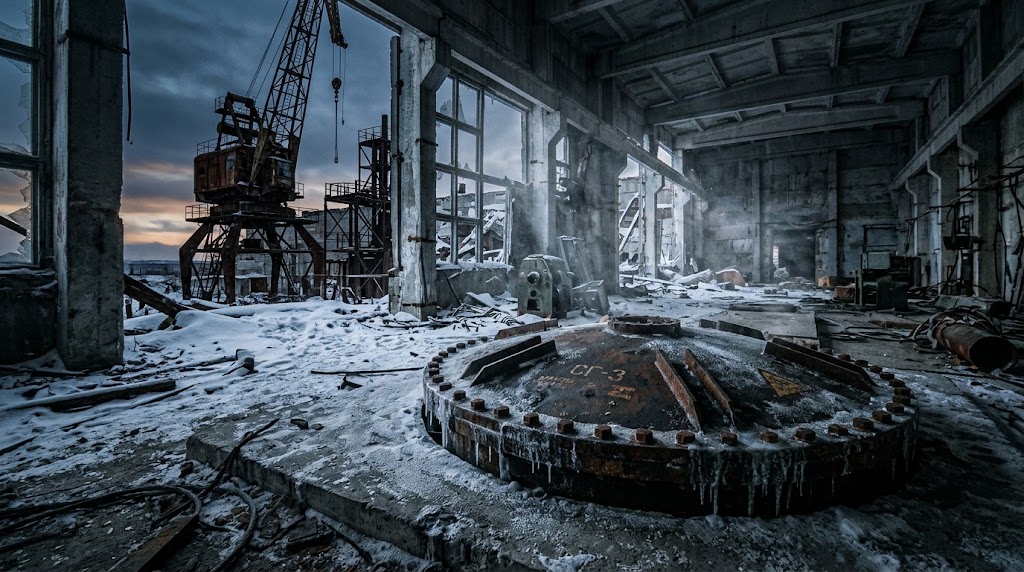
Today, the research station lies in abandoned ruins amidst Arctic blizzards. In the center of the derelict drill hall sits a modest, heavy steel cap, barely nine inches across, secured with thick industrial weld points and heavy bolts. Stamped into the cold iron is a faded serial number: 12,262m. Beneath that disc lies an empty vertical abyss plunging into the burning heart of the world—a monument to human daring.







Post Comment