The Wow! Signal: The 72-Second Interstellar Whisper That Mystified Modern Astronomy
Detection Snapshot: Channel 2 Anomaly
Timestamp: August 15, 1977 | 22:16 EDT • Origin: Constellation Sagittarius • Signature: 6EQUJ5 (Peak: 30x Background Radiation)
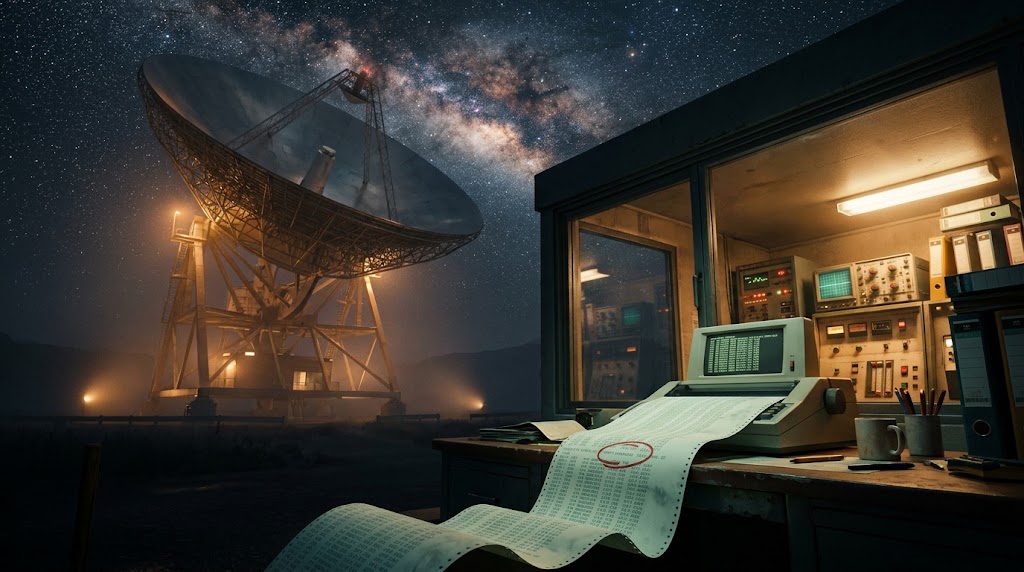
On the humid summer evening of August 15, 1977, a routine observation shift at the Ohio State University’s Radio Observatory—affectionately nicknamed the “Big Ear”—quietly altered the trajectory of modern astrophysics forever. While the rest of the world was engrossed in late-seventies pop culture and Cold War tensions, a young volunteer astronomer named Dr. Jerry R. Ehman was meticulously parsing through stacks of fresh dot-matrix computer printouts.
In those days, radio observatories did not feature high-resolution digital monitors or real-time color spectrographs; they chattered mechanically, printing raw alphanumeric telemetry onto perforated green-and-white continuous paper. As Ehman scanned line after line of ambient cosmic static, his red pen suddenly stopped mid-air.
Clustered together in a tight, narrow vertical column was a sequence of six characters that defied every established statistical probability of the natural universe: 6EQUJ5. Transfixed by the mathematical impossibility of the reading, Ehman instinctively circled the code in bold red ink and scribbled a single, unvarnished human exclamation in the margin: “Wow!”
Deconstructing the Code: Why 6EQUJ5 Stunned Scientists
To comprehend why the scientific community reacted with such intense shock, one must understand how Big Ear recorded cosmic data. The telescope did not record sound waves, voice signals, or musical tones; it measured the intensity of electromagnetic radiation across fifty distinct frequency channels.
To save physical horizontal space on the narrow paper printout, the university’s IBM 1130 mainframe computer converted numerical intensity values into a base-36 alphanumeric scale:
- Digits 1 through 9: Indicated signal strength just slightly above empty cosmic noise (baseline background).
- Letters A through Z: Once the signal intensity reached 10, the computer transitioned to letters (A = 10, B = 11, C = 12).
- The Letter ‘U’: The zenith of the Wow! transmission reached the letter ‘U’, representing a signal intensity between 30.0 and 30.999 times stronger than the background radiation of empty space.
Intensity Level
30 | [U] (Peak 30x Over Baseline)
20 | [Q] [J]
10 | [E] [5]
00 |–[6]————————————> Time (Duration: 72s)
The 72-Second Bell Curve: The Mechanical Fingerprint of Deep Space
Perhaps the most extraordinary technical detail of the Wow! Signal was its duration: precisely 72 seconds. This was not a arbitrary number chosen by an extraterrestrial civilization; it was the exact mechanical footprint of the Big Ear telescope itself.
Big Ear was a transit telescope—it was completely fixed in place and did not rotate to track objects across the night sky. Instead, it stared steadily into the cosmos while the natural 24-hour rotation of Earth swept its receiving horns across the celestial sphere. Given the physical geometry of the telescope’s dual horns, any stationary cosmic point source located at infinite celestial distance would take exactly 72 seconds to pass across the receiver’s field of view.
The signal did not spike erratically. It entered the antenna perimeter softly, swelled symmetrically over 36 seconds to maximum power as it centered in the receiver, and decayed symmetrically over the remaining 36 seconds. It matched the theoretical bell curve of an astronomical deep-space point source with mathematical perfection.
“The signal was so clean, so narrow, and so mathematically harmonious with the hydrogen line that if you asked an engineer to design an interstellar calling card, they would have handed you the Wow! Signal.”
— Dr. John Kraus, Director of the Ohio State Radio Observatory
The Sacred Frequency: 1420.405 MHz (The Hydrogen Line)
If an advanced civilization wished to establish contact across interstellar gulfs, what frequency would they select? In 1959, physicists Giuseppe Cocconi and Philip Morrison published a landmark study in Nature asserting that extraterrestrial minds would naturally gravitate toward 1420.405 MHz—the resonant frequency of neutral hydrogen.
Hydrogen is the most abundant element in the universe. Any intelligent species possessing the technology to listen to the stars would build detectors tuned to this universal wavelength. For this reason, astronomers refer to this band as the “Cosmic Water Hole”—a neutral meeting frequency for galactic minds.
When the Ohio State researchers computed the Doppler-corrected frequency of the Wow! transmission, it registered at 1420.4556 MHz—less than 50 kilohertz away from the hydrogen line. Furthermore, natural astronomical radio sources like pulsars or supernovas broadcast across broad bands. The Wow! Signal was concentrated in a hyper-narrow bandwidth of under 10 kHz, an unequivocal hallmark of an engineered, artificial transmitter.
💡 Why Haven’t We Heard It Again?
Despite subsequent decades of monitoring with the Very Large Array (VLA) in New Mexico and the Arecibo Observatory in Puerto Rico, the signal never repeated. In modern observational astronomy, a non-repeating event is impossible to independently verify, leaving it frozen as an unsolved empirical anomaly.
Evaluating the Natural Hypotheses
Over the past half-century, skeptics and astrophysicists have attempted to explain away the phenomenon with terrestrial or natural causes:
- The 2017 Comet Theory: A widely publicized theory proposed that passing comets (such as 266P/Christensen) released hydrogen clouds that caused the emission. However, this was overwhelmingly dismissed by the astronomical community; comets do not generate intense, pin-point, narrow-band transmissions 30 times stronger than deep space, nor do they disappear completely within minutes.
- Military Radar Reflection: Could it have been an undocumented Cold War radar reflection bouncing off a piece of space debris? Analysis of satellite tracking records confirmed no orbital objects were in the path of the antenna during that 72-second window. Furthermore, 1420 MHz is internationally protected spectrum reserved strictly for passive radio astronomy.
- An Interstellar Lighthouse: The hypothesis that the signal was a deliberate, high-powered planetary radar beam scanning across the plane of the Milky Way remains statistically and physically viable.
An Enduring Cosmic Legacy
The Big Ear radio telescope was dismantled in 1998 to make way for a golf course community. Yet, the physical paper printout bearing Jerry Ehman’s enthusiastic red-ink notation remains carefully preserved in the Ohio History archives. It stands as an enduring monument to humanity’s unending search for meaning in the dark—a 72-second cosmic whisper that proved our species is finally capable of listening to the cosmos, even if we are not yet ready to decode the answer.







Post Comment