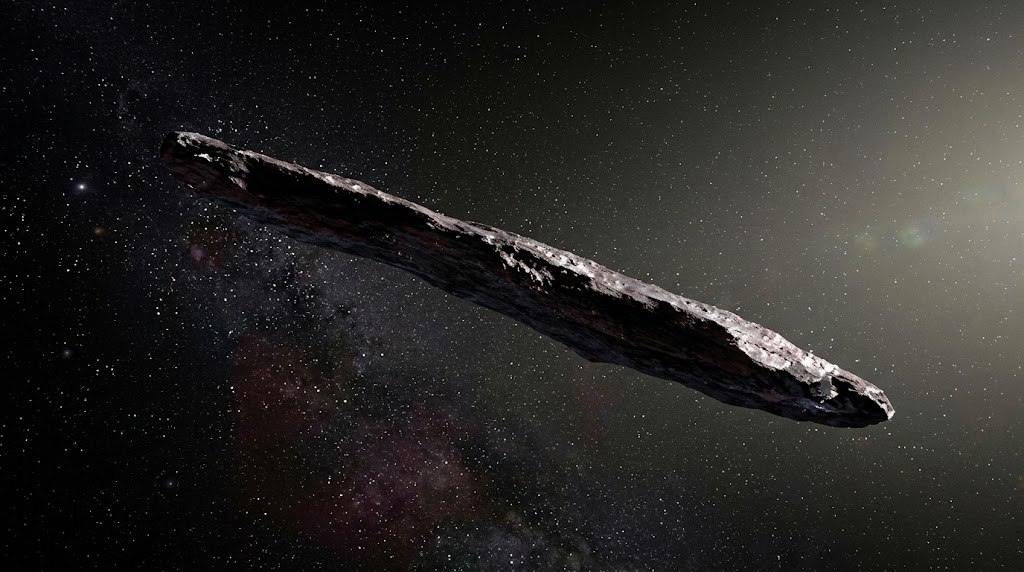
The Oumuamua Intrusion: When an Accelerating Interstellar Traveler Defied Modern Astronomy
Designation: 1I/2017 U1 (‘Oumuamua)
Discovery: Oct 19, 2017 (Pan-STARRS1) • Origin: Extrasolar / Vega Direction • Eccentricity: 1.20 (Hyperbolic Escape) • Aspect Ratio: ~10:1
On October 19, 2017, the automated Pan-STARRS1 survey telescope perched atop the volcanic peak of Haleakala in Hawaii picked up a faint pinpoint of light streaking across the predawn sky. At first glance, astronomers cataloged it as an unremarkable near-Earth asteroid.
However, when orbital dynamicists calculated its trajectory, the astronomical community was sent into a state of collective shock. The object’s orbital eccentricity stood at an unprecedented **1.20**. It was traveling on a steep hyperbolic trajectory at an astounding velocity of **87 kilometers per second (over 190,000 mph)** relative to the Sun. It was not bound by solar gravity; it had arrived from the distant interstellar void between stars.
The International Astronomical Union officially designated it **1I/2017 U1**, christening it with the Hawaiian name ‘Oumuamua, meaning “a messenger from afar arriving first.” It was the first macroscopic interstellar object ever confirmed in human history—and every single piece of data it left behind contradicted modern planetary science.
The Bizarre Anatomy of a Cosmic Ghost
Because ‘Oumuamua was already speeding away from Earth upon discovery, world observatories—including the Hubble Space Telescope and the European Southern Observatory’s Very Large Telescope in Chile—scrambled to capture photometric light curves before it vanished into darkness.
The resulting observational data revealed characteristics unlike any asteroid or comet ever documented in the solar system:
- The Extreme Aspect Ratio: The brightness of ‘Oumuamua varied periodically by a factor of ten every 7.3 hours as it tumbled end-over-end. This implied an unprecedented geometry: it was at least ten times longer than it was wide, shaped either like a **400-meter needle-thin cigar** or an ultra-thin cosmic pancake.
- Dense Metallic Reflectance: Spectrographic analysis revealed a dark reddish hue, heavily irradiated by cosmic rays over hundreds of millions of years in interstellar space, resembling iron-nickel asteroids or organic tholins.
The Mystery of the Non-Gravitational Acceleration
The greatest scientific controversy erupted in mid-2018. When researchers analyzed high-precision trajectory tracking, they discovered that as ‘Oumuamua swung around the Sun and sped toward interstellar space, **it was accelerating**. Something was physically pushing it faster than could be accounted for by the gravitational pulls of the Sun, planets, or general relativity.
Measured Velocity: Exceeded gravitational Newtonian predictions
Cometary Outgassing: ABSENT (No dust coma, no cyanide, no carbon detected)
Spitzer Space Telescope: Infrared sensor detected ZERO water vapor or CO2 gas
Rotational Stability: Showed zero rocket-thrust torque spin-up
In standard astronomy, comets accelerate via “outgassing”—solar heat vaporizes buried ice, creating jets of gas that act like miniature rocket thrusters. But deep-space infrared observations by the Spitzer Space Telescope proved that ‘Oumuamua released **zero gas, zero dust, and possessed no visible coma**. If it was outgassing enough mass to cause that acceleration, the resulting torque would have spun the elongated object so violently that it would have shattered into rubble.
“If ‘Oumuamua was propelled by natural cometary jets, where was the dust? Where was the gas? The only hypothesis that naturally explains the acceleration without requiring invisible outgassing is radiation pressure acting upon an artificial ultra-thin surface.”
— Dr. Avi Loeb, Frank B. Baird Jr. Professor of Science at Harvard University
The Extraterrestrial Hypothesis: Was It a Light Sail?
In late 2018, Dr. Avi Loeb, former chair of the Astronomy Department at Harvard University, published a peer-reviewed paper in The Astrophysical Journal Letters proposing an audacious hypothesis: ‘Oumuamua could be an artificial artifact—a defunct interstellar **light sail** crafted by an extraterrestrial technological civilization.
Under Loeb’s model, if the object possessed a thickness of less than one millimeter with a large surface area, solar radiation pressure alone—photons of sunlight bouncing off its reflective surface—would naturally produce the exact non-gravitational acceleration recorded by astronomers without requiring any gas expulsion.
Mainstream astronomers countered with natural explanations, suggesting the object was an exotic iceberg composed of pure solid molecular hydrogen ($H_2$) or nitrogen ice calved from an exoplanet’s crust. Yet, critics pointed out that a hydrogen iceberg would have sublimated long before surviving the hundreds of millions of years required to cross interstellar voids.
The Messenger Departs
Today, ‘Oumuamua has crossed past the orbit of Pluto, fading forever beyond the reach of humanity’s most powerful optical telescopes. We will never catch it. Yet, its brief, enigmatic passage fundamentally revolutionized modern astronomy, proving that our solar system is not an isolated bubble—and leaving behind a chilling riddle about what other silent messengers might be traversing the interstellar night.








Post Comment