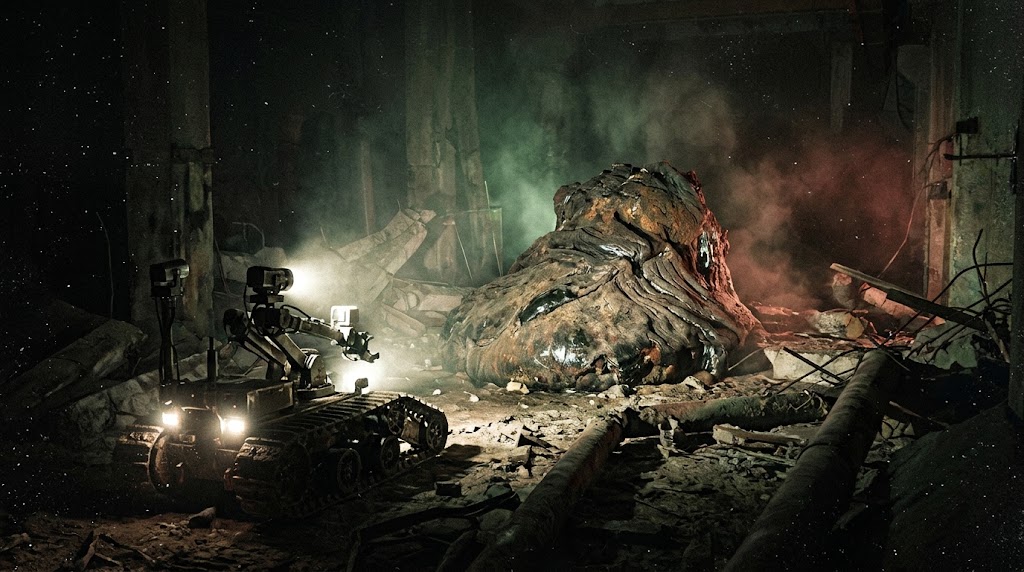
The Elephant’s Foot and the Pioneer Robots: Extreme Robotics Inside Chernobyl Reactor 4
Target: Corium Mass (The Elephant’s Foot)
Location: Room 217/2, Under Reactor No. 4 • Radiation Field (1986): 10,000 Roentgens/Hour • Lethal Dose: ~300 Seconds of Exposure
In the terrifying aftermath of the April 26, 1986 catastrophe at the Chernobyl Nuclear Power Plant in Soviet Ukraine, human beings discovered the absolute biological limits of organic flesh. When the core of Reactor No. 4 exploded, releasing an inferno of radioactive isotopes into the atmosphere, the environment surrounding the shattered reactor building became the most violently hostile environment on planet Earth.
To clear the reactor roof of pulverized graphite fuel blocks emitting thousands of roentgens per hour, Soviet authorities initially attempted to deploy state-of-the-art remote-controlled robots. However, the machines failed almost immediately: the invisible blizzard of gamma radiation destroyed the microprocessors within minutes, sending robotic bulldozers careening off the edge of the roof.
Faced with total mechanical failure, a clandestine team of Soviet nuclear physicists and robotics engineers—calling themselves The Complex Expedition—embarked upon a mission into the pitch-black subterranean catacombs beneath the reactor floor. Their goal was to design custom, radiation-hardened robotic probes to locate hundreds of tons of missing, melted nuclear fuel: a lethally toxic material known as Corium.
The Birth of Corium: The Lava of the Apocalypse
During the catastrophic thermal runaway of Reactor 4, temperatures within the reactor vault exceeded 2,600°C (4,700°F). At this extreme heat, the uranium dioxide fuel rods, zirconium alloy cladding, boron control rods, and thousands of tons of serpentine sand and crushed concrete melted together into a dense, bubbling, radioactive radioactive magma.
This synthetic lava burned straight through the reinforced concrete floor of the reactor pit, cascading down drainage pipes like molten volcanic glass into the subterranean steam distribution corridors beneath the building. When it cooled and hardened in room 217/2, it formed a wrinkled, blackish-grey metallic mass weighing approximately two metric tons. Because of its wrinkled, curved appearance, physicists named it “The Elephant’s Foot”.
Surface Radiation: 10,000 Roentgens per hour
30-Second Exposure: Dizziness, fatigue, immune suppression
120-Second Exposure: Acute radiation sickness, hemorrhaging
300-Second Exposure (5 Min): Fatal within 48 hours (LD100 guaranteed)
Composition: Uranium, Zirconium, Silicon dioxide, Graphite
Why Radiation Destroys Silicon Brains
Why did ordinary electronic robots collapse within minutes inside the reactor building? The answer lies in the physics of semiconductor architecture:
- Single Event Effects (SEE): Modern microprocessors rely on microscopic silicon transistors switched on or off by microscopic electrical charges. High-energy gamma photons ripping through silicon liberate cascades of secondary electrons, causing bits to flip randomly in memory—a phenomenon that crashes software logic instantly.
- Total Ionizing Dose (TID): Over sustained exposure, gamma radiation physically degrades the oxide insulation layers within transistors, causing permanent electrical leakage, total circuit lockup, and physical melting of microscopic copper interconnects.
“When you looked through the video monitors of the early exploration rovers, you could physically see the radiation. It looked like dense, swirling snow falling across the image—gamma rays smashing directly into the camera’s CCD sensor.”
— Dr. Artur Korneyev, Nuclear Safety Inspector
The Pioneer Robots: Extreme Engineering from the Space Race
Faced with the failure of standard electronics, Soviet authorities turned to the **VNII Transmash** research institute—the legendary defense laboratory that had designed the Soviet *Lunokhod* lunar rovers that rolled across the moon in the 1970s.
Engineers designed custom, hardened rovers utilizing revolutionary techniques:
- Analog Pneumatic Control: Rather than relying on digital silicon microprocessors, early exploration probes utilized pneumatic air logic and heavy analog relay circuits encased in inches of solid lead and tungsten shielding.
- Periscope Optical Systems: Instead of placing sensitive solid-state digital cameras near the front of the vehicle, robots utilized long periscopic mirror relays, keeping the optical sensors isolated behind lead bulkheads.
- Tethered Fiber Optics: Radio control signals were completely scattered by the heavy steel and concrete ruins; engineers steered the vehicles using heavy-duty, armored fiber-optic cables spooled out from the rear of the tracked chassis.
🎯 Sampling the Beast with an AK-47
When scientists needed to analyze the chemical composition of the Elephant’s Foot, the hardened material was so tough that remote drills burned out. In a moment of extreme improvisation, researchers mounted an AK-47 rifle onto a remote-controlled trolley and fired armor-piercing rounds directly into the mass to chip off small fragments for laboratory testing.
The Legacy of Extreme Machine Design
The lessons forged in the radioactive ruins of Chernobyl laid the foundations for the entire discipline of modern extreme robotics. The radiation-hardening techniques perfected in those dark subterranean corridors are deployed today in interplanetary space probes exploring Jupiter’s intense radiation belts, deep-sea research submersibles, and modern disaster recovery operations.
Today, the Elephant’s Foot sleeps beneath the colossal 36,000-ton New Safe Confinement arch erected over the ruins of Reactor 4. Its radiation has decayed significantly over four decades, yet it remains an enduring monument to technological hubris—and the tireless machines that sacrificed their silicon circuits to contain the beast.










Post Comment