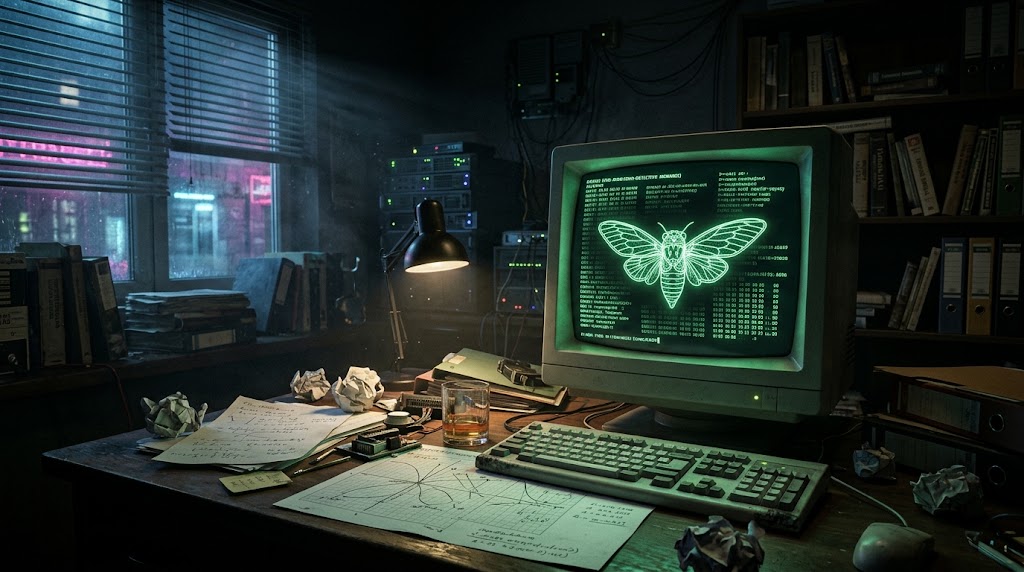
The Cicada 3301 Enigma: The Internet’s Most Elusive Cryptographic Treasure Hunt
Case: The Cicada 3301 Broadcasts
First Contact: January 4, 2012 • Signature: PGP Key ID: 7A35090F • Physical Clues: 12 Cities Across 5 Continents • Status: Partially Deciphered
On the morning of January 4, 2012, an anonymous user published an unremarkable, low-resolution black-and-white image on an underground technology message board. Against a stark black backdrop stood six lines of stark white text that would spark the most complex, obsessive, and globally distributed intellectual treasure hunt in the history of the modern internet:
“Hello. We are looking for highly intelligent individuals. To find them, we have devised a test.
There is a message hidden inside this image. Find it, and it will lead you on the road to finding us. We look forward to meeting the few that will make it all the way through.
Good luck. 3301.”
To casual web surfers, the post was dismissed as the pretentious ramblings of an internet prankster or an alternate-reality marketing stunt for an upcoming video game. But within hours, an international collective of mathematical prodigies, intelligence agency cryptanalysts, and cyber-security researchers descended down a rabbit hole that shattered the boundary between the digital realm and physical geopolitical reality.
The Digital Rabbit Hole: Steganography and Ancient Ciphers
The initial clue was not written in the visible text. Solvers with expertise in digital forensics subjected the raw image file to steganography—the ancient art of hiding secret information within ordinary digital carrier files. Opening the JPEG file inside a hexadecimal text editor revealed a hidden string appended beyond the end-of-file marker:
TIBERIVS CLAVDIVS CAESAR says "lxxt>>33m2mqkyhumso Tolxhoh"
This clue directed researchers to the Roman Emperor Claudius—a historical nod to the classic Caesar substitution cipher. Shifting the characters by Claudius’s regnal position (four) unlocked an obscure URL hosting an image of a duck. That duck image, in turn, contained another layer of hidden text extracted using the cryptographic tool OutGuess, which pointed to a subreddit filled with encrypted Mayan numerology, King Arthurian legend, and book-cipher references to the Welsh epic The Mabinogion.
[Original Image File] ──> (Hex Edit Extraction) ──> Caesar Shift Cipher (Tiberius)
│
▼
[OutGuess Steganography] ──> (Extracts PGP-Signed Text) ──> Book Cipher (Agrippa)
│
▼
[Telephone Voice Anomaly] ──> Automated Texas Number Plays Morse Code Coordinates
│
▼
[Physical GPS Drops] ──> QR Code Posters Taped to Street Lamps on 5 Continents
Crucially, every single clue was signed with an authentic, uncrackable Pretty Good Privacy (PGP) digital signature: 7A35090F. If a puzzle piece did not bear this mathematical stamp, the community knew it was a counterfeit decoy. Cicada operated with military cryptographic discipline.
Breaking Into the Physical World: GPS Coordinates Across 5 Continents
Just when hackers assumed Cicada was merely an intricate keyboard puzzle, the creators executed a masterstroke that terrified security analysts. A deciphered clue unlocked a working telephone number registered in Texas: (214) 390-9608.
When callers dialed the number, an automated synthetic voice answered, reading a sequence of prime numbers followed by a cryptic riddle. Translating those numbers yielded **14 precise GPS coordinates scattered across five continents**:
Seattle, Los Angeles, New Orleans, Miami, Hawaii
Paris (France), Warsaw (Poland), Granada (Spain)
Seoul (South Korea), Okinawa (Japan), Sydney (Australia)
In the dead of night, amateur sleuths around the world physically traveled to these exact coordinates. Fixed to streetlamps, telephone poles, and alleyway walls, they found physical laminated posters bearing an illustration of a cicada bug alongside a black-and-white QR code.
The realization was chilling: whoever was running Cicada 3301 was not a lone hacker in a bedroom. They possessed operatives, financial logistics, and physical boots on the ground spanning from Tokyo and Warsaw to Sydney and Seattle simultaneously.
The Unsolved Masterpiece: Liber Primus
In subsequent iterations, Cicada released a 73-page illustrated manuscript titled Liber Primus (“First Book”), penned entirely in an unknown runic alphabet derived from ancient Anglo-Saxon Futhark.
📜 The Deciphered Philosophy of Liber Primus
To date, only 17 of the 73 runic pages have ever been successfully translated. The decoded passages read like an esoteric philosophical manifesto: “An end is a new beginning. Command your own self. Every man is a tiny world. Preservation of privacy is the preservation of consciousness.” The remaining 56 pages remain an uncracked fortress of zero-knowledge mathematics.
Who Was Behind Cicada 3301?
Over a decade of investigation, three primary theories have emerged regarding the true nature of Cicada 3301:
- State Intelligence Agency Recruitment: Many researchers believe Cicada was an elite, non-traditional recruitment pipeline engineered by agencies such as the CIA, NSA, MI6, or Israel’s Unit 8200 designed to identify off-grid cryptographic savants who would never respond to conventional job advertisements.
- A Sovereign Cypherpunk Collective: Others argue Cicada was a wealthy, clandestine alliance of early privacy libertarians, cryptographers, and technologists dedicated to building uncrackable, decentralized anonymity tools to safeguard human freedom against global surveillance states.
- A Covert Defense Think Tank: A privately funded global security syndicate stress-testing cryptographic systems for advanced commercial zero-knowledge infrastructure.
“When you finally solved the final Tor hidden service link in the first wave, you were asked to enter a personal PGP key. A few weeks later, an email arrived inviting successful solvers to a private encrypted IRC channel. We were told Cicada was an international group working on privacy software. And then, without warning, the servers went dark.”
The Sudden Silence
In April 2017, a final signed PGP message was broadcast to the global cryptography community: “Beware false paths. Always verify signature from 7A35090F.” Since that day, Cicada 3301 has maintained total, impenetrable radio silence.
Cicada 3301 remains the quintessential digital enigma of the connected age. In a world where every satellite pulse is tracked, every smartphone monitored, and every database cataloged, it demonstrated that an anonymous collective could project power across five continents, craft uncrackable ciphers, and disappear into the digital night—leaving behind a masterclass in the infinite beauty of mathematics.







Post Comment