Stuxnet: The 500-Kilobyte Code Weapon That Shattered Nuclear Centrifuges
Code Name: Olympic Games (Stuxnet)
File Size: ~500 Kilobytes • Zero-Day Vulnerabilities: 4 Simultaneous Exploits • Target: Siemens S7-300 PLCs / IR-1 Centrifuges • Impact: ~1,000 Centrifuges Destroyed
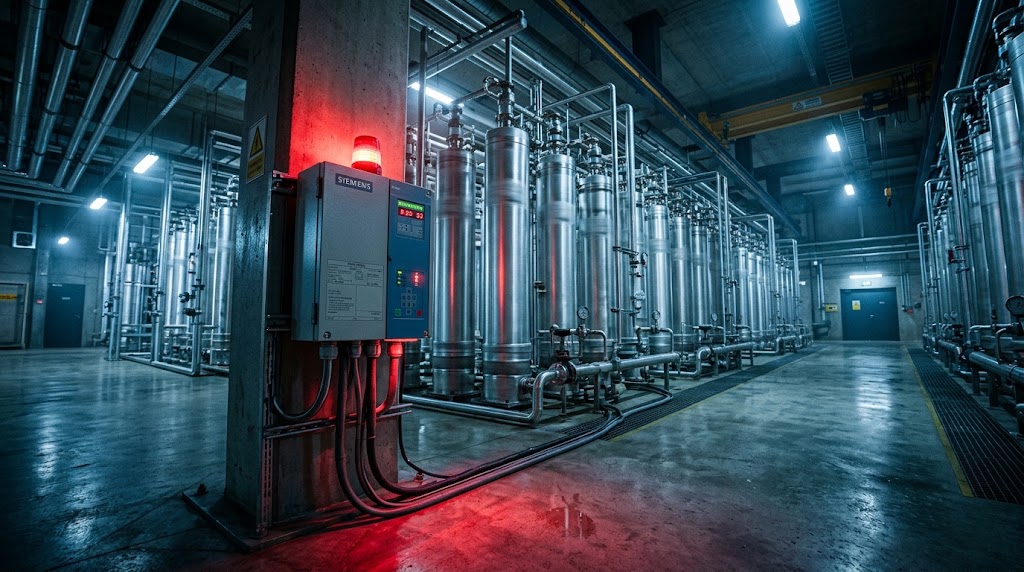
In early 2010, inspectors from the International Atomic Energy Agency (IAEA) walking through the underground uranium enrichment facility at **Natanz, Iran**, noticed a baffling phenomenon. Iranian nuclear technicians were systematically replacing hundreds of delicate, high-speed **IR-1 gas centrifuges** that were tearing themselves apart at an unprecedented failure rate.
The Iranian engineers were visibly bewildered. Their digital control screens in the sterile command room reported that every single pressure sensor, coolant valve, and rotational motor was operating in flawless mathematical equilibrium. Yet on the cascade floor below, giant aluminum cylinders spinning at **63,000 revolutions per minute (over supersonic speeds)** were violently shaking, exploding, and shattering into scrap metal.
What the Iranian nuclear scientists were witnessing was the kinetic aftermath of the world’s first true cyber weapon: a weapon forged not of steel, high explosives, or missile propellant, but of **500 kilobytes of malicious binary code known as Stuxnet**.
Breaching the Air Gap: The Anatomy of the Infiltration
The Natanz facility was thought to be impenetrable. Built deep subterranean beneath reinforced layers of concrete, the plant’s supervisory control and data acquisition (SCADA) network was **completely air-gapped**—physically isolated from the global internet, public telecommunications lines, and external servers.
To cross that physical void, the creators of Stuxnet (widely acknowledged by intelligence historians as a joint US-Israeli operation codenamed “Operation Olympic Games”) engineered a masterpiece of cyber infiltration:
- The USB Flash Drive Vector: Stuxnet was slipped into Natanz via ordinary USB flash drives carried into the plant by third-party industrial contractors.
- Four Unprecedented Zero-Day Exploits: In the cybersecurity underworld, a single zero-day exploit—an unpatched security flaw unknown to software vendors—is worth hundreds of thousands of dollars. Stuxnet unleashed four separate zero-days simultaneously, including the infamous Windows `.LNK` shortcut vulnerability (MS10-046) that executed malware the microsecond a USB drive was viewed in Windows Explorer without requiring any user click.
- Stolen Digital Certificates: To evade detection by commercial antivirus software, the worm was signed with authentic, stolen cryptographic certificates from major Taiwanese hardware manufacturers Realtek and JMicron, making the malware look 100% legitimate to operating systems.
The Digital Heist: How Stuxnet Blinded the Operators
What set Stuxnet apart from all malware that preceded it was its surgical restraint. When it infected an ordinary computer, it did nothing. It quietly inspected the system: if the PC was not connected to specific **Siemens Step 7 industrial software** controlling frequency-converter drives manufactured by Fararo Paya in Iran or Vacon in Finland, Stuxnet went completely dormant.
Once it confirmed it was inside Natanz, it executed an attack reminiscent of a Hollywood heist movie:
Phase 1: Pre-Attack Surveillance (Records 21 days of normal sensor telemetry)
│
▼
Phase 2: The Optical Illusion (Replays recorded normal data to operator monitors)
│
▼
Phase 3: The Sabotage Spike (Spins rotors from 1,064 Hz to 1,410 Hz for 15 minutes)
│
▼
Phase 4: Resonant Frequency Drop (Drops speed to 2 Hz; harmonic vibrations destroy rotors)
For weeks, Stuxnet recorded normal operational telemetry from the centrifuges. When it initiated the attack, it hijacked the PLC controller and fed the **pre-recorded normal telemetry loop back to the operators’ monitors**, showing peaceful, stable readings. Meanwhile, behind the scenes, it sped the centrifuges up to dangerous velocities, then plunged their speed suddenly through the centrifuge’s resonant frequency—causing the aluminum rotors to flex, wobble, and physically disintegrate into shrapnel.
“Stuxnet crossed the Rubicon. It demonstrated that software could transcend the digital realm and cause physical, mechanical destruction in the real world just like a precision airstrike.”
— Ralph Langner, Control System Security Specialist Who Decoded Stuxnet
The Escaped Monster and the Cyber Doctrine
Stuxnet succeeded in setting Iran’s uranium enrichment timetable back by an estimated two years, destroying roughly 1,000 centrifuges. However, due to a minor programming error in a subsequent code update, the worm escaped the Natanz facility onto a contractor’s laptop and spread into the wild internet, where cybersecurity researchers at Belarus-based VirusBlokAda discovered it in June 2010.
The Dawn of Fifth-Domain Warfare
The discovery of Stuxnet permanently redefined international military doctrine. It demonstrated to every superpower on Earth that cyberspace is the fifth domain of warfare, alongside land, sea, air, and space. A sequence of malicious electrical pulses travelling down a USB port could cripple a nation’s critical infrastructure without leaving a radar trace or firing a single bullet.
Today, the Stuxnet code sits decomposed in malware repositories across the globe—a historic, terrifying artifact of the moment when cyberspace became lethal.









Post Comment