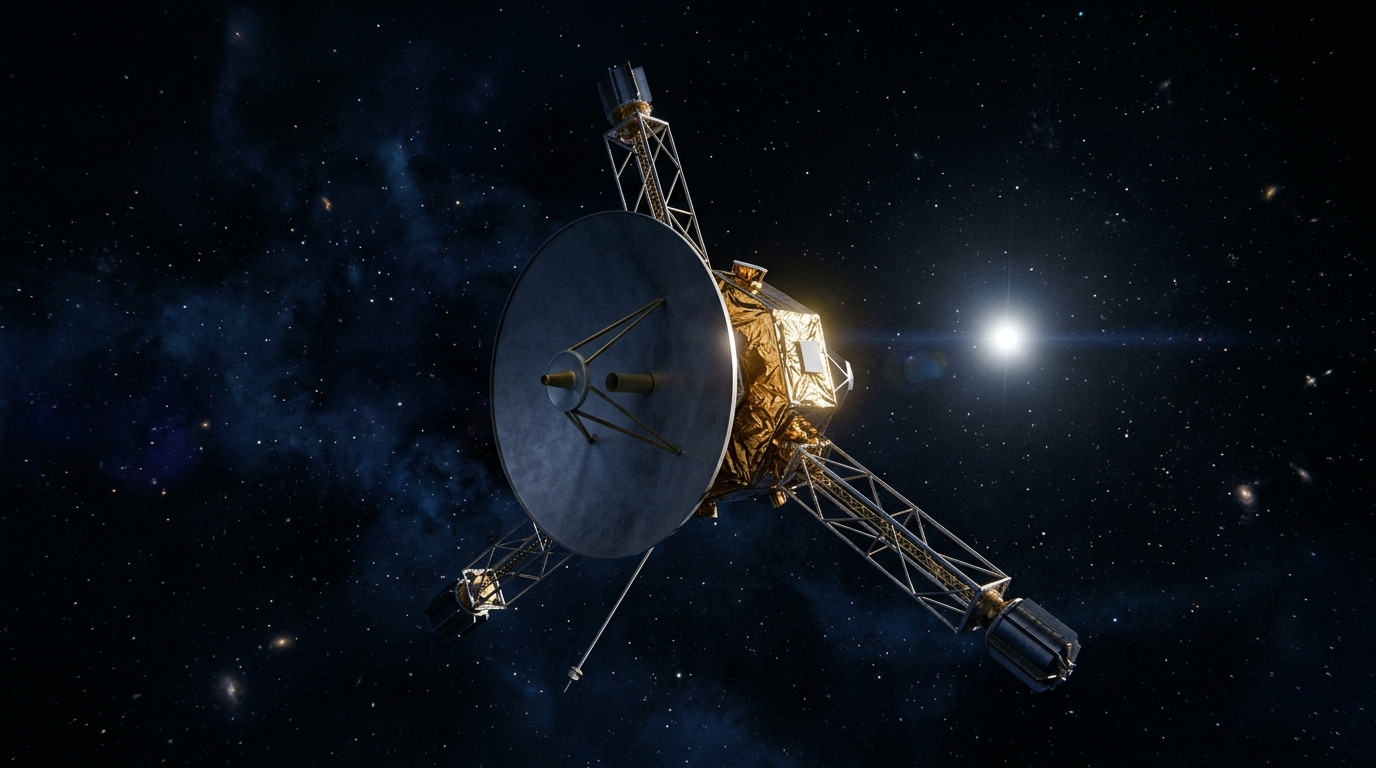
The Pioneer Anomaly: The Ghost Drag at the Solar System’s Edge That Tested Einstein
Anomaly Profile: The Sunward Acceleration
Target Probes: Pioneer 10 & Pioneer 11 • Distance: >20 AU • Unexplained Drift: ~400 km/year • Investigation Duration: 30+ Years
In March 1972, NASA launched Pioneer 10 on a bold historic trajectory into the uncharted outer reaches of our solar system. It was the first human artifact designed to traverse the treacherous Asteroid Belt, capture the first close-up photographs of Jupiter’s swirling Great Red Spot, and achieve escape velocity to drift permanently into the interstellar void.
The mission was a triumphant masterpiece of Cold War aerospace engineering. Having fulfilled its primary scientific objectives, the probe continued hurtling silently past Saturn, Uranus, and Neptune toward the dark periphery of the heliosphere. Deep space tracking stations operated by NASA’s **Deep Space Network (DSN)** in California, Spain, and Australia maintained continuous radio contact, utilizing ultra-precise microwave Doppler measurements to plot the probe’s trajectory against Einsteinian general relativity.
However, by 1980, when Pioneer 10 crossed beyond 20 Astronomical Units (AU)—nearly two billion miles from Earth—navigation specialists at the Jet Propulsion Laboratory (JPL) detected a microscopic, persistent mathematical error. The probe was not where classical celestial mechanics predicted it should be. Something out in the frozen blackness was gently, relentlessly pulling the spacecraft back toward the Sun.
The Mathematical Ghost in the Telemetry
To ordinary observers, the discrepancy seemed negligible. The anomalous acceleration amounted to approximately:
a_p = (8.74 ± 1.33) × 10^-10 m/s^2
Cumulative Trajectory Deflection: ~400 Kilometers Per Year
Direction of Force Vector: Directed Exactly Sunward (Centripetal)
Confirmed Vehicles: Pioneer 10 AND Pioneer 11 (Identical Signatures)
An acceleration of less than one nanometer per second squared is barely equivalent to the weight of a single snowflake falling on a sheet of paper. Yet, over astronomical distances and decades of silent coasting, this infinitesimal drag caused the spacecraft to fall behind its predicted orbital coordinates by hundreds of kilometers every single year.
Crucially, when astrophysicists analyzed the independent tracking telemetry of its twin sister ship, Pioneer 11—which was speeding in the diametrically opposite direction across the solar system—they uncovered the exact same unexplained sunward pull. It was not a mechanical quirk of a single vehicle; it appeared to be a universal physical phenomenon operating at the edge of known space.
Did General Relativity Break Down?
For more than twenty years, the **Pioneer Anomaly** emerged as one of the most hotly contested debates in theoretical physics. Because NASA’s planetary ephemeris software accounted for all known gravitational forces—the Sun, all nine planets, dozens of moons, large asteroids, and solar wind radiation pressure—physicists began questioning the foundations of modern cosmology:
- Modified Newtonian Dynamics (MOND): Could gravity behave differently at extreme interstellar distances? Proponents of alternative gravity theories argued that at microscopic acceleration thresholds, Newton and Einstein’s inverse-square laws broke down.
- Dark Matter Halos: Others theorized that the probes were traversing a previously undetected halo of cold dark matter encircling the solar perimeter, exerting a faint gravitational drag.
- Cosmological Expansion Coupling: Radical theorists suggested the drag was a local coupling effect of the expansion of the universe itself, acting upon isolated deep-space masses.
“When you have two independent spacecraft traveling in opposite directions through deep space, both exhibiting the exact same unexplained sunward deceleration, you have to entertain the possibility that your fundamental physics may be incomplete.”
— Dr. Slava Turyshev, Senior Research Scientist at NASA JPL
The Digital Archeology Rescue Mission
By the early 2000s, resolving the mystery seemed impossible: the original magnetic telemetry tapes from the 1970s were decaying in cardboard boxes, recorded on obsolete 9-track magnetic formats readable only by defunct Cold War mainframe computers. Pioneer 10 itself had sent its final, dying whisper to Earth in January 2003 before its radio transmitter succumbed to the deep freeze.
Dr. Slava Turyshev and a dedicated team of aerospace historians launched an epic forensic rescue effort. They scoured NASA warehouses, university basements, and retired engineers’ garages, recovering over 40 gigabytes of raw Doppler telemetry spanning three decades. They digitized the vintage magnetic media and reconstructed the complete thermodynamic history of the Pioneer spacecraft using state-of-the-art supercomputer thermal modeling.
💡 The Breakthrough Solution: The Thermal Recoil Force
In 2012, after simulating over 400,000 individual surface polygons, the mystery was finally unmasked: the drag was not dark matter or broken relativity, but thermal recoil pressure. The probe’s onboard plutonium Radioisotope Thermoelectric Generators (RTGs) were radiating heat. A tiny fraction of those infrared photons bounced off the back of the large 2.7-meter parabolic high-gain antenna, creating a subtle, constant photonic thrust pushing the probe backward toward the Sun!
The Triumph of Forensic Science
The resolution of the Pioneer Anomaly stands as one of the greatest triumphs of astronomical forensics in modern history. It reaffirmed the majestic durability of Einstein’s general relativity while teaching aerospace engineers a profound lesson in deep-space precision: across decades in the cosmic vacuum, even the pressure of invisible heat escaping from a metallic shell can mimic a phantom force of nature.
Today, Pioneer 10 drifts silently through the Oort cloud, headed toward the red star Aldebaran in the constellation Taurus—a ghost ship carrying humanity’s golden plaque into the timeless dark.








Post Comment