The Voynich Manuscript: How Modern AI and Computational Linguistics Are Tackling History’s Greatest Cipher
Artifact: Beinecke MS 408 (The Voynich Manuscript)
Carbon Dating: 1404 – 1438 AD • Length: 240 Vellum Pages • Language: “Voynichese” (Unidentified) • Status: Undeciphered
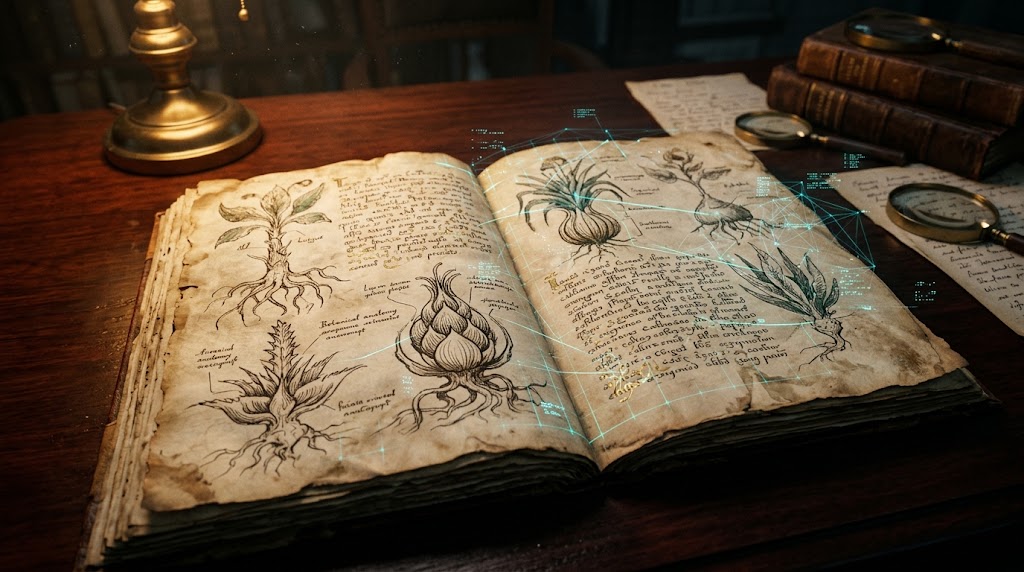
Locked securely inside the climate-controlled vaults of Yale University’s Beinecke Rare Book and Manuscript Library rests an enigmatic artifact officially cataloged as MS 408. To historians, codebreakers, and computer scientists, it is known by a far more legendary title: The Voynich Manuscript.
Consisting of approximately 240 pages of calfskin vellum, the codex is handwritten in an elegant, looping script consisting of a completely unknown alphabet. Scattered across its pages are surreal, hand-painted illustrations of bizarre botanical specimens that do not correspond to any known living plant species on Earth, intricate astronomical zodiac dials, and complex network diagrams of miniature human figures wading through tubes of emerald-green liquid.
For more than a century, the manuscript has resisted the analytical minds of world-class cryptanalysts. The master codebreakers of Britain’s Bletchley Park—the mathematical geniuses who broke Nazi Germany’s Enigma cipher during World War II—attempted to crack the Voynich text and conceded total defeat. The United States National Security Agency (NSA) convened special task forces to analyze its statistical character frequency and failed. Today, a new vanguard has entered the arena: deep learning neural networks, natural language processing (NLP), and supercomputing algorithms.
The Mathematical Illusion: Is It a Language or a Brilliant Hoax?
The foremost question that has haunted computational linguists for generations is straightforward: does the text represent authentic, encoded human communication, or is it an elaborate, meaningless 15th-century forgery designed to sell to wealthy royal collectors?
When computational researchers subjected the text to mathematical entropy calculations, the manuscript revealed a stunning truth: it behaves identically to natural, organic human languages.
Zipf’s Law Compliance: PASS (Matches English, Latin & Arabic)
Word Entropy (H): 3.8 to 4.4 bits (True Natural Language Range)
Repetition Metric: Extreme Reduplication (e.g., “qokedy qokedy”)
Radiocarbon Certainty: 95% Confidence Interval: 1404 – 1438 AD
The manuscript strictly conforms to Zipf’s Law—a fundamental mathematical law of natural language stating that the frequency of any given word is inversely proportional to its rank in the frequency table. Creating a fraudulent text in the year 1420 that unconsciously complied with mathematical statistical laws discovered in the 20th century would have been physically and mathematically impossible for a Renaissance forger.
The Enter of Neural Networks and NLP
With the explosion of artificial intelligence and deep neural networks, researchers at leading computer science institutions began training large language models to uncover the hidden architecture of the text:
- The University of Alberta Machine Translation Experiment (2018): Computer scientists Greg Kondrak and Bradley Hauer deployed an algorithm trained on the Universal Declaration of Human Rights in 380 different languages to determine the base language of the manuscript. The statistical output pointed to an anagrammed form of ancient Hebrew with an algorithmic confidence of 97%.
- The Anagrammatic Hypothesis: The AI model hypothesized that the author took an existing Semitic dialect, stripped out the vowel markings, reordered the letters within each word according to a fixed substitution cipher, and transcribed them into custom glyphs. When the model translated the first line of the herbal section, it produced the phrase: “She made recommendations to the priest, man of the house, and me and people.”
“The manuscript possesses an internal structural discipline that is almost frightening. There are zero crossed-out words, zero scribal hesitations, and zero visible corrections across 240 vellum pages. Whoever wrote it possessed an algorithmic clarity.”
— Dr. Greg Kondrak, Professor of Natural Language Processing
The Bizarre Structural Anomalies
Despite AI breakthroughs, modern computational linguistics has encountered bizarre roadblocks that make the manuscript even stranger:
- The Phenomenon of Extreme Word Reduplication: In Voynichese, identical words frequently appear twice or three times in immediate succession (e.g., “qokeey qokeey qokeey”). While reduplication exists in languages like Indonesian or Hebrew for emphasis, it occurs in Voynichese at statistical frequencies unseen in any known human tongue.
- Total Lack of Word-Length Variance: Natural languages feature wide variations in word length, ranging from single-letter prepositions to twenty-letter compound nouns. Voynichese words are unnaturally uniform, clustering almost exclusively between five and six characters in length.
- Curious Line Boundaries: Words that appear at the end of a line rarely appear at the beginning of a line. This suggests that the spatial positioning on the vellum page held cryptographic significance—a technique known in classical steganography as a “cardan grille” system.
💡 Radiocarbon Certainty Eliminates Modern Forgery
In 2009, a team of scientists at the University of Arizona conducted multi-sample carbon-14 dating on four distinct pages of the manuscript. The analysis confirmed with 95% certainty that the calfskin vellum was manufactured between 1404 and 1438 AD, permanently disproving theories that it was forged by modern antiquarians or 16th-century occultists like John Dee.
The Intersection of Medieval Mysticism and Future Computing
The Voynich Manuscript represents the ultimate collision of distant antiquity and cutting-edge computer science. It stands as an unbroken mirror reflecting humanity’s perpetual obsession with secrecy. Whether it is ultimately unlocked as an encyclopedic treatise of medieval pharmacological alchemy, an esoteric religious grimoire written in an extinct northern Italian dialect, or a bespoke synthetic language, the manuscript remains undefeated.
Until supercomputing transformer models achieve definitive consensus, MS 408 will preserve its sacred silence—reminding modern cryptographers that a solitary medieval scribe with goose quill and ink could craft a cipher capable of defying the collective intellect of the 21st century.








Post Comment